
How to Become a Cadre Mathematics Lecturer: A Complete Step-by-Step Guide
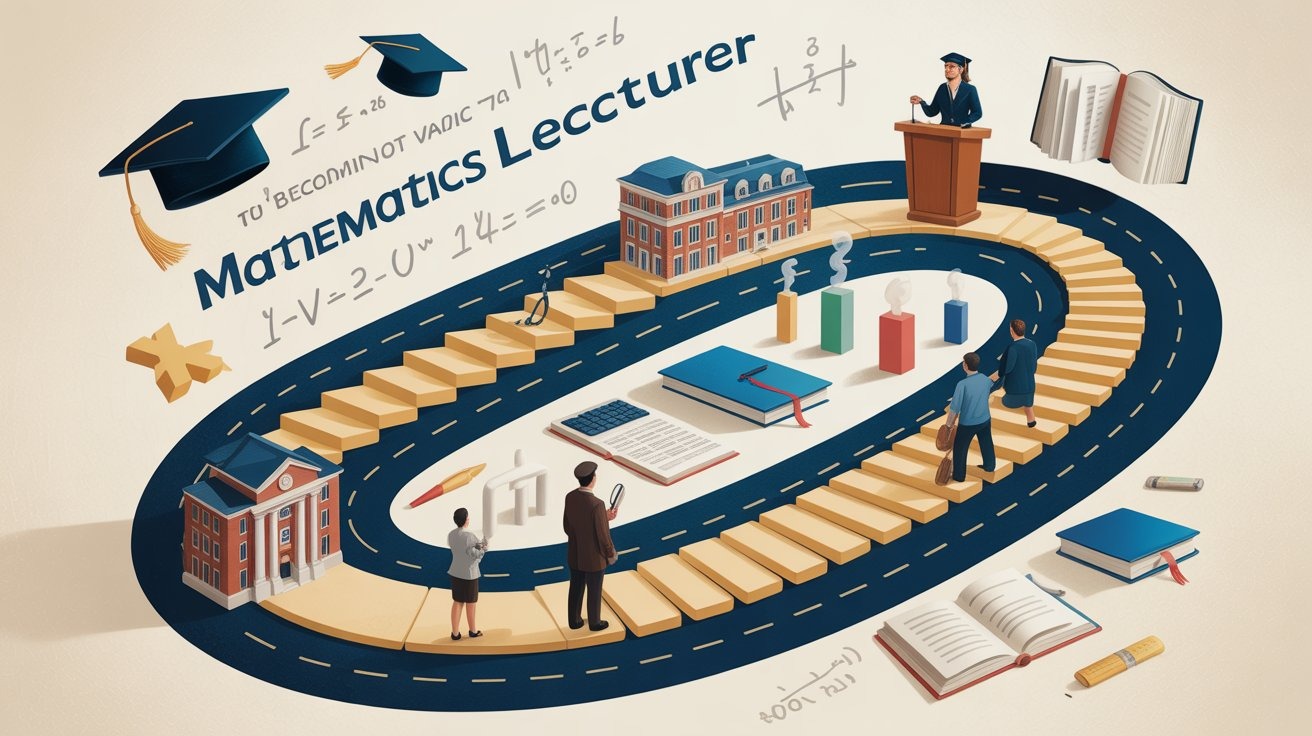
If you have a strong command of mathematics and a genuine desire to teach, becoming a Lecturer Cadre Mathematics teacher is a career worth pursuing seriously. But the path is not always straightforward. You need to clear a competitive exam, meet specific eligibility criteria, and prepare strategically for a structured written test. That is where enrolling in the right Lecturer Cadre Mathematics programme makes all the difference.
Each year, thousands of graduates apply for Lecturer Cadre (PGT) posts in states like Punjab, Himachal Pradesh, and Haryana, yet only a fraction crack the exam on their first attempt. Understanding the full roadmap, from educational qualifications to exam day strategy, gives you a measurable advantage over the competition.
This guide covers everything you need to know about how to become a mathematics lecturer, including eligibility conditions, exam structure, syllabus highlights, and the preparation habits that top-ranking candidates swear by. Read it carefully, take notes, and use it as a reference throughout your preparation journey.
What Does a Mathematics Cadre Lecturer Actually Do?

Understanding the Role Before You Pursue It
A mathematics lecturer is responsible for delivering subject content to Class 11th and 12th Students in schools. The role goes beyond simply standing in front of a classroom. Lecturers design lesson plans, assess student performance, conduct tutorials, and contribute to the academic environment of the institution. In government schools, this position also comes with structured pay scales, job security, and opportunities for career progression into senior academic roles.
In Punjab, for example, the Lecturer Cadre post is among the most sought-after government teaching jobs for mathematics graduates. Positions are filled through the PSSSB, and the selection process is competitive enough to require months of focused preparation. Knowing what the role demands helps you align your preparation accordingly from day one.
For more information, check out: https://onlinemim.com/lecturer-cadre-mathematics-science/
Mathematics Lecturer Eligibility: What You Need to Qualify
Breaking Down the Academic and Age Requirements
Before you think about studying for the exam, you need to confirm that you meet the Mathematics lecturer eligibility criteria. These requirements are set by the conducting authority, and candidates who do not satisfy them are rejected at the application stage itself. Here are the key conditions most state commissions specify:
- Academic Qualification: You must hold an M.Sc. in Mathematics from a recognised university with a minimum aggregate of 55% marks, and a B.Ed. is mandatory
- Age Limit: Generally 37 years. States like Punjab offer relaxations of up to 5 years for SC/ST candidates and 3 years for OBC candidates under government norms.
- Nationality: You must be an Indian citizen and, in some states, a domicile of that particular state to be eligible for a government lecturer post.
- Additional Qualifications: Some states may additionally require candidates to have a B.Ed degree.
It is always a good idea to check the official notification of the specific commission you are applying to, as the Mathematics lecturer eligibility criteria can vary slightly by state. For instance, Himachal Pradesh may have slightly different rules compared to Punjab or Haryana.

Understanding the Lecturer Cadre Mathematics Exam Pattern
What the Written Test Looks Like and How It Is Scored
The Lecturer Cadre Mathematics exam is typically a written, objective-type paper conducted by state public service commissions. While the exact structure can vary, the general format widely followed across states like Punjab is as follows:
- Total questions: 150 multiple-choice questions
- Total marks: 150 (one mark per correct answer)
- Duration: 2 hours and 30 minutes
- Negative marking: Generally absent, but confirm from the official notification
- Medium: The paper is set in English and Punjabi for Mathematics
The Lecturer Cadre Mathematics exam tests candidates primarily on core 11th-12th Maths, graduation, and postgraduate-level mathematics topics. There is no separate general studies or reasoning paper in most states, so the focus remains entirely on subject knowledge. This makes it essential to build a strong conceptual foundation across all major branches of mathematics.
Check out the NET exam details with personalised guidance: https://onlinemim.com/csir-net-maths/
Lecturer Cadre Maths Syllabus: What You Are Expected to Know
Core Topics That Appear Most Frequently in the Exam
The Lecturer Cadre Maths syllabus covers advanced topics from postgraduate mathematics. While the exact distribution of marks may differ, the following subjects form the backbone of almost every state-level exam in this category. Here is what you should expect:
- Class 11th–12th Mathematics: Topics from the PSEB senior secondary curriculum, including sets, relations, functions, trigonometry, coordinate geometry, vectors, probability, and statistics.
- Abstract Algebra: Groups, rings, fields, subgroups, normal subgroups, homomorphisms, Sylow theorems, polynomial rings, and Field Theory.
- Linear Algebra: Vector spaces, linear transformations, matrices, eigenvalues, eigenvectors, inner product spaces, and canonical forms.
- Calculus: Functions, limits, continuity, differential calculus, and integral calculus in one or more variables.
- Real Analysis: Sequences and series, continuity, differentiability, Riemann integration, uniform convergence, and metric spaces.
- Complex Analysis: Analytic functions, Cauchy-Riemann equations, complex integration, Taylor and Laurent series, and residue theorem.
- Topology: Topological spaces, open and closed sets, compactness, connectedness, and continuity in topological spaces.
- Differential Equations: Ordinary and partial differential equations, boundary value problems, and methods of solution, including Laplace transforms.
- Numerical Analysis: Interpolation, numerical integration, solutions to algebraic equations, and numerical methods for ODEs.
- And many other topics like: Calculus of Variations, Integral Equations, Classical Mechanics, LPP, and Statistics.
Understanding the full Lecturer Cadre Maths syllabus from the start helps you divide your preparation time wisely. For instance, if you are stronger in algebra than analysis, you can allocate more weekly hours to analysis early in your schedule rather than discovering the gap two weeks before the exam.
More details: https://onlinemim.com/lecturer-cadre-mathematics-science/
How to Become a Mathematics Lecturer: Building a Realistic Preparation Plan
A Month-by-Month Strategy That Actually Works
Knowing how to become a mathematics lecturer means more than ticking academic boxes. It means building a preparation strategy that respects both the depth of the syllabus and the structure of your daily life. Many candidates fail not because they lack knowledge, but because they do not plan their study schedule realistically.
Here is a practical framework that works well for most candidates:
- Months 1 and 2: Begin with Class 11th–12th Mathematics topics such as sets, relations, functions, trigonometry, coordinate geometry, vectors, probability, and statistics. Then move to Calculus, covering functions, limits, continuity, differential calculus, and integral calculus. Do not attempt mock tests yet. Focus entirely on understanding concepts, not memorising formulas.
- Months 3 and 4: Move to advanced postgraduate topics, including Abstract Algebra (groups, rings, fields, and Field Theory), Linear Algebra, Real Analysis, and Complex Analysis. Begin solving previous year papers from similar state exams to understand question patterns and difficulty levels.
- Month 5: Cover the remaining topics, including Topology, Differential Equations, Numerical Analysis, and other areas like Calculus of Variations, Integral Equations, Classical Mechanics, LPP, and Statistics. Start timed mock tests alongside. Aim to complete at least 3 full-length mock papers per week. After each test, analyse your errors and revise those specific topics.
- Month 6: This is your consolidation phase. Revisit weak areas, redo wrong questions from earlier mocks, and ensure all parts of the syllabus have been covered at least twice.
Mathematics Lecturer Preparation Tips That Give You an Edge
Study Habits and Mindset Shifts That Top Scorers Use
Clearing a state-level Lecturer Cadre Mathematics exam is not just about how many hours you study. It is about how effectively those hours are used. The following Mathematics lecturer preparation tips are drawn from the habits of candidates who have successfully cracked these exams:
- Prioritise depth over breadth: It is better to know 70% of the syllabus thoroughly than to have a surface-level familiarity with 100% of it. Examiners test conceptual clarity, not superficial coverage.
- Solve previous year papers early: Begin attempting past papers from at least the third month of your preparation. This gives you a realistic picture of what the exam tests and how much time each section requires.
- Practice under timed conditions: The 2.5-hour exam requires strong time management. Practising with a timer from early on ensures you can comfortably attempt all 150 questions without rushing toward the end.
- Join a structured coaching programme: Self-study works for highly disciplined candidates, but most aspirants benefit from external structure, doubt-clearing sessions, and regular assessment. Coaching institutes provide all three together.
- Revise consistently, not just before the exam: Set aside at least 90 minutes every week purely for revision of topics you have already covered. Spaced repetition dramatically improves long-term retention of complex mathematical content.
These Mathematics lecturer preparation tips sound simple, but applying them consistently over a 6-month preparation cycle is what separates successful candidates from those who need a second attempt.

What You Gain From Expert-Led Preparation Over Self-Study
Many candidates underestimate the difficulty of the Lecturer Cadre exam until they attempt their first mock test. The questions are not just difficult in isolation. They are designed to test whether you can apply concepts across topics under time pressure. This is precisely why Lecturer Cadre Mathematics from a specialised institute is valuable beyond just having study material.
A good coaching programme offers structured classes that follow the official syllabus, regular test series that simulate real exam conditions, one-on-one doubt sessions where you can get specific questions resolved, and expert insights into which topics are more heavily weighted in recent papers. For candidates preparing for the Lecturer Cadre Mathematics exam while also managing other commitments, online coaching with recorded lectures provides the flexibility to study at your own pace without missing expert guidance.
The MIM Academy offers both offline and online coaching for the Lecturer Cadre exam, with batches designed specifically around the exam pattern and syllabus. Students who enrol get access to updated study material, a comprehensive test series, previous year paper discussions, and personalised academic support throughout the preparation period.
Documents and Application Process: Getting the Formalities Right
What You Need to Submit When the Recruitment Notification Arrives
Once a Lecturer Cadre recruitment notification is released by the state public service commission, the application window is usually open for 3 to 4 weeks. Missing the deadline or submitting incorrect documents is a common reason candidates get disqualified before the exam even begins. Here is what you typically need to have ready:
- Scanned copy of your M.Sc. degree certificate or final year mark sheet
- Proof of age, such as a birth certificate or a Class 10 mark sheet
- State domicile certificate, if required by the commission
- Category certificate for SC/ST/OBC if you are applying under the reserved quota
- Passport-size photograph and signature in the specified format and file size
- Payment confirmation of the application fee, which varies by state and category
Keep digital copies of all documents organised in one folder so that you can upload them quickly when the notification is out. State commissions do not accept applications after the deadline under any circumstances.
Conclusion: Your Path to a Government Lecturer Post Starts Now
Becoming a Lecturer Cadre Mathematics teacher in a government school is one of the most rewarding career paths for a mathematics graduate. It offers stability, respect, and the satisfaction of contributing meaningfully to students’ academic journeys. But the competition is real, and the exam demands thorough preparation.
Start by confirming your Mathematics lecturer eligibility, then map the Lecturer Cadre Maths syllabus against your current knowledge. Build a 6-month preparation schedule, practise rigorously with previous year papers, and work on your weaker areas with consistency. If you want to give yourself the strongest possible foundation, MIM Academy is where hundreds of successful candidates have begun and completed their journey. Enrol today and take the first concrete step toward your goal.
Visit MIM Academy for course details, batch schedules, and enrolment.
Frequently Asked Questions (FAQs)
Q1.What is the salary of a Lecturer in a Punjab government college?
A Lecturer Cadre (PGT) teacher in Punjab earns approximately Rs. 35,400 per month as basic pay under Pay Level 10 of the 7th Pay Commission, with a gross salary of around Rs. 45,000–50,000 per month after allowances.
Q2. Is the Lecturer Cadre exam held every year?
No, the Lecturer Cadre exam is not held annually; it is conducted by PSSSB only when vacancies arise, with gaps of two to four years between recruitment cycles.
Q3. Difference between the Lecturer Cadre and the Master Cadre in Punjab?
Master Cadre teachers teach Classes 6th to 10th with a bachelor’s degree and B.Ed., while Lecturer Cadre (PGT) teachers teach Classes 11th and 12th with an M.Sc. and B.Ed., carrying a higher pay scale.
Q4. Can I apply for the Lecturer Cadre without NET?
Yes, UGC NET is not required for the Lecturer Cadre (PGT) post in Punjab, as selection is based solely on the PSSSB written exam.
Q5. How many months of preparation are enough to clear the Lecturer Cadre Mathematics exam?
Most successful candidates prepare for 5 to 6 months with a structured plan. Those joining a dedicated coaching programme often find their preparation more focused and efficient, reducing the time needed to cover the full syllabus.
| Start Your Journey to Becoming a Mathematics Lecturer Today
Get expert coaching, structured study plans, and personalised mentorship at MIM Academy. Whether you are just starting or looking to sharpen your exam strategy, our dedicated faculty is here to guide you every step of the way. Enrol in Lecturer Cadre Mathematics Now Call: +91 9876311001 | Email: mathsmim@gmail.com | Visit: onlinemim.com |