
How to Prepare for IIT JAM Mathematics: A Complete Guide for 2026 Aspirants

If you are wondering how to prepare for IIT JAM Mathematics, you are not alone. Every year, a large number of candidates appear for IIT JAM Mathematics to compete for admission to MSc Mathematics and related postgraduate programmes at IITs. The exam tests 60 questions worth 100 marks across three sections, covering topics from Class 12 level right up to undergraduate Real Analysis and Linear Algebra.
This guide walks you through the official eligibility criteria, the marking scheme, the exam pattern, the syllabus, and the admission process that follows, along with a workable study plan.
Understanding the IIT JAM Maths Syllabus Before You Start
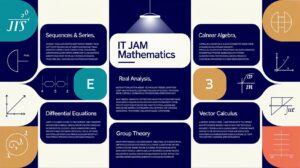
Begin by understanding the official IIT JAM Mathematics syllabus before starting detailed study. It is divided into three broad areas: Real Analysis, Linear Algebra and Algebra, and Multivariable Calculus with Differential Equations. Knowing what falls inside each area saves you from studying topics that will never appear in the paper. Most aspirants print the official syllabus from the JAM 2026 website and tick off topics as they finish them.
Official Eligibility Criteria for IIT JAM Mathematics 2026
The official eligibility criteria for IIT JAM Mathematics require a bachelor’s degree in Mathematics or a related subject from a recognised university. General, OBC NCL, and EWS candidates need a minimum of 55 percent aggregate marks or equivalent CGPA, while SC, ST, and PwD candidates need at least 50 percent. Final-year students can also apply, provided they submit proof of completing their degree by the date their institute specifies. There is no age limit, and both Indian and foreign nationals are eligible. Requirements vary slightly by programme, so cross-check the JAM 2026 Admission Brochure.
Real Analysis and Calculus Topics That Carry the Most Weight
Sequences and series, continuity, differentiability, and Taylor’s theorem appear almost every year. Multivariable calculus, including partial derivatives and multiple integrals, is another heavyweight section. Treat these as non-negotiable topics.
Linear Algebra and Algebra Concepts You Cannot Skip
Vector spaces, matrices, eigenvalues, and group theory form the backbone of the algebra section. Many students underestimate this portion, yet it often decides the final rank. Ordinary and partial differential equations round out the syllabus and connect closely with the calculus portion. Practising these alongside Linear Algebra, rather than as a separate topic later, helps you notice patterns examiners frequently test together.
Official Marking Scheme for IIT JAM Mathematics 2026
Understanding the official marking scheme matters just as much as the syllabus. In Section A, a wrong answer costs one third mark on a one mark question and two thirds mark on a two mark question. Section B and Section C carry no negative marking, and unattempted questions are never penalised. Since B and C carry no risk, attempt every question there, while approaching Section A with more caution.
IIT JAM Mathematics 2026 Exam Pattern
The exam pattern for IIT JAM Mathematics 2026 remains a three hour computer based test with 60 questions worth 100 total marks, divided across three compulsory sections, as summarised below.
| Section | Question Type & Count | Marks | Negative Marking |
| Section A (MCQ) | 30 questions (10 of 1 mark, 20 of 2 marks) | 50 | 1/3 mark for 1 mark Qs, 2/3 mark for 2 mark Qs |
| Section B (MSQ) | 10 questions, 2 marks each | 20 | No negative marking, no partial marking |
| Section C (NAT) | 20 questions (10 of 1 mark, 10 of 2 marks) | 30 | No negative marking |
Candidates use a mouse for MCQ and MSQ answers, while NAT answers go through a virtual numeric keypad since the keyboard is disabled. An online calculator is provided, and personal calculators are not permitted.
Official Syllabus PDF Reference
The complete section-wise syllabus for IIT JAM Mathematics, covering Sequences and Series, Real Analysis, Integral Calculus, Differential Equations, Vector Calculus, Group Theory, Linear Algebra, and Algebra, is published on the official JAM 2026 syllabus page maintained by IIT Bombay. Downloading it directly from the official website, rather than a third-party platform, ensures you prepare against the exact topics notified for the current cycle.
Building an IIT JAM Maths Preparation Strategy That Works
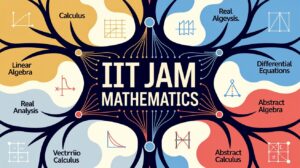
A solid IIT JAM Maths preparation strategy starts with honest self-assessment. Take one full-length mock test in week one, before any serious revision, just to see where you currently stand. This baseline score tells you which chapters need the most attention over the coming months.
From there, divide your day into three blocks: new concept learning, problem solving, and revision of earlier topics. Aim for at least four hours of focused study daily if you are a working graduate, or six hours if JAM is your only priority right now.
Why Concept Clarity Beats Rote Memorisation
JAM Mathematics rewards candidates who understand why a theorem works, not just what it states. When you can derive a result yourself, tricky variations in the exam stop feeling unfamiliar. Spend extra time proving standard theorems instead of memorising their statements alone.
How to Prioritise High Weightage Chapters First
Real Analysis and Linear Algebra together account for a large share of the paper’s marks historically. Start here, then move to Differential Equations and Vector Calculus. Save less frequently tested topics, like certain algebra subtopics, for the final revision phase.
Creating a Realistic IIT JAM Maths Study Plan

An effective IIT JAM Maths study plan spans roughly eight to ten months, assuming you start right after finishing your second year of BSc. Break this into three phases: foundation building, intensive practice, and final revision with mock tests.
A rough split looks like this: four months for foundation, three months for intensive problem solving, and two months purely for mocks and revision. Adjust these numbers slightly if you are also managing college exams or a job alongside your preparation.
A Sample Monthly Study Plan Breakdown
Months one to four: cover Real Analysis, Linear Algebra, and basic Calculus, one chapter at a time, with weekly self tests. Months five and six: move into Multivariable Calculus, Differential Equations, and Algebra, revisiting earlier chapters each Sunday. Month seven onward: shift to previous year papers and full length mocks, at least two a week, with a single error log for weak areas.
Admission Process After JAM
Once results are declared, the admission process moves entirely through the JOAPS portal. Qualified candidates register, pay the counselling fee, and fill institute and programme choices by rank. Seat offers arrive across multiple admission lists. On receiving one, a candidate chooses Accept and Freeze, Accept with Upgrade, or Reject and Quit, then pays the seat booking fee within the deadline to confirm it. Those who upgrade stay in the running for later rounds, while those who freeze secure their seat and exit. Admitted candidates finally download their offer letter and report to the institute with original documents for verification.
Expert IIT JAM Maths Tips to Boost Your Score
These practical IIT JAM Maths tips come from analysing patterns across several years of question papers. First, always attempt Numerical Answer Type questions before guessing on Multiple Choice ones, since there is no negative marking on NAT and MSQ sections. Second, solve at least ten years of previous papers, not just three or four.
Third, keep a formula notebook from day one instead of trying to create one in the last month. Fourth, join a peer study group of three or four people so you can discuss tricky proofs out loud, which tends to expose gaps in understanding much faster than solo revision alone.
Common Mistakes Aspirants Make and How to Avoid Them
Many candidates spend months on textbooks without ever practising under timed conditions, then panic on exam day. Others ignore weaker chapters entirely instead of building at least basic familiarity. At MIM Academy, mentors regularly see students improve marks simply by fixing time management during mock tests.
Last Month Preparation Tips Before Exam Day
In the final thirty days, stop learning new topics altogether. Focus purely on revision, formula sheets, and full length mocks scheduled at the exact time of your actual exam slot. Sleep and diet matter here too, since a tired mind forgets formulas far faster than a rested one.
Keep the last three or four days almost entirely light. Skim your formula notebook once a day, avoid new mock tests, and get a full night’s sleep before the exam. Aspirants who over study in the final 48 hours often report more silly mistakes on exam day than those who ease off deliberately.
Final Thoughts
Cracking this exam ultimately comes down to consistency rather than raw talent. Once you understand how to prepare for IIT JAM Mathematics through a structured syllabus review, a realistic study plan, and disciplined mock test practice, the entire process feels far less intimidating.
If you would like personalised mentorship and a structured test series along the way, MIM Academy‘s JAM Mathematics coaching programme has helped many students strengthen exactly these fundamentals.
| Ready to Crack IIT JAM Mathematics?
Get expert-led coaching, structured mock tests, and personal mentorship built around the exact JAM Mathematics syllabus. |
Frequently Asked Questions
What is the best way to start preparing for IIT JAM Mathematics as a beginner? Start by mapping the syllabus, then move to weak chapter revision before attempting mock tests.
How many hours should I study daily for IIT JAM Maths? Four to six focused hours daily, depending on your college schedule, work well for most aspirants.
Which topics carry the highest weightage in the JAM Mathematics syllabus? Real Analysis, Linear Algebra, and Calculus together carry the largest share of marks.
How many previous year papers should I solve before the exam? Solving at least ten years of previous papers builds strong pattern recognition and speed.
Is coaching necessary to clear IIT JAM Mathematics? Coaching is not mandatory, but structured mentorship can speed up correcting weak areas significantly.