
Which Books are Best for Master Cadre Maths Preparation?
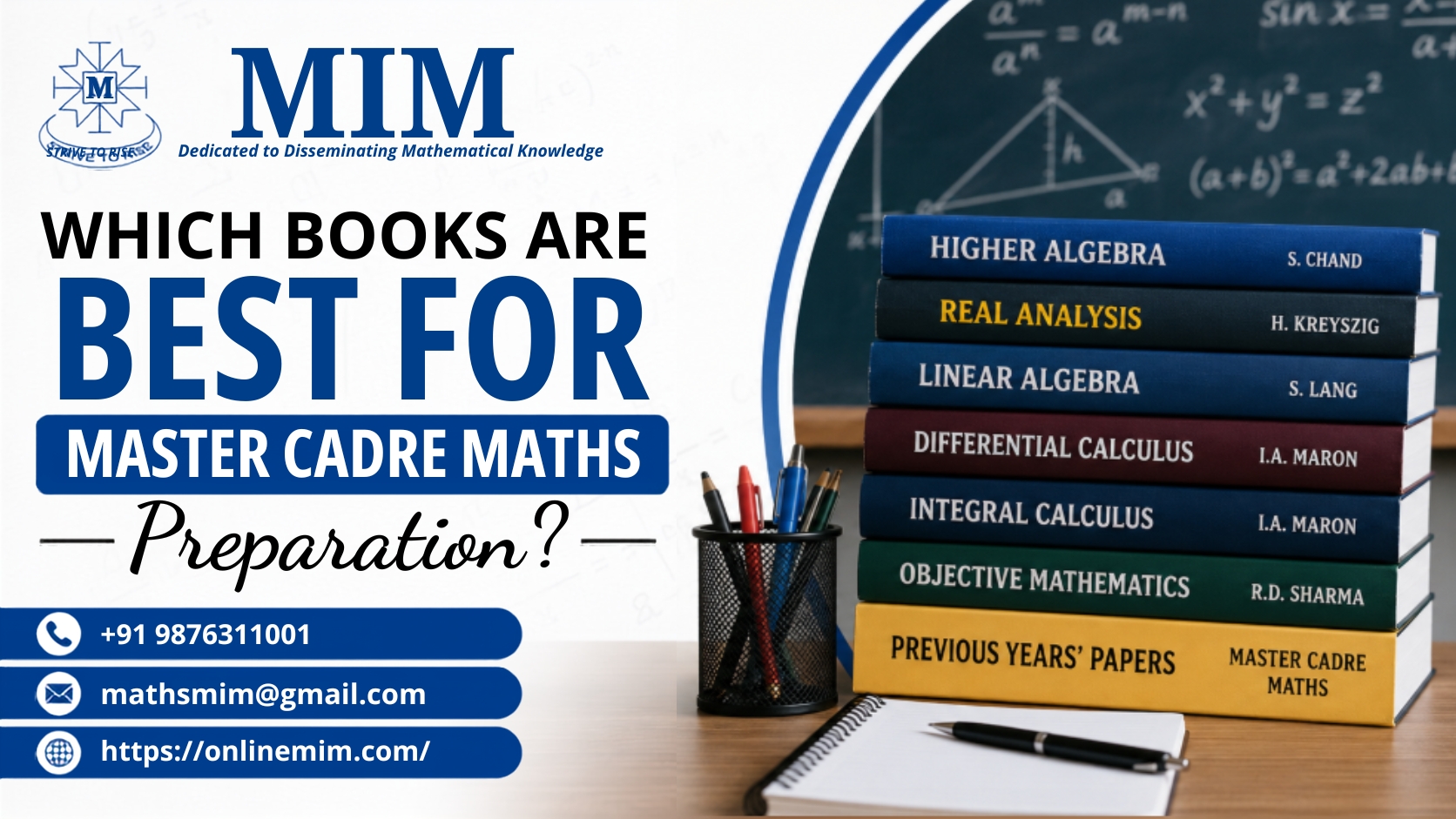
Choosing the best books for Master Cadre Maths is often more confusing than the syllabus itself. Most aspirants preparing for Punjab Master Cadre Maths preparation ends up collecting ten different books, three sets of coaching notes, and dozens of PDFs, only to realise halfway through that half of it repeats the same topics and the rest doesn’t even match the exam pattern. This guide skips the random book-name dumping and instead organizes resources by purpose, so you know exactly what to pick up first, what to use for revision, and what to leave on the shelf. By the end, you’ll have a clear, workable Master Cadre Maths book list instead of a pile of half-finished material.
How to Choose the Best Books for Master Cadre Maths
Before picking up any book, it helps to know what a genuinely useful resource for this exam looks like. A good book for Master Cadre Maths preparation should map closely to the current Master Cadre Maths syllabus, use the same terminology and question style the exam actually uses, and progress logically from concept explanation to solved examples to practice questions. It should also be recent enough to reflect any syllabus or pattern changes, and it should not overlap too heavily with material you already own.
A simple filter works well here: does this resource build a concept, help you practice it, or help you revise it? If a book doesn’t clearly fall into one of these roles, it’s probably not adding value, no matter how popular it is in study groups.
Best Books for Master Cadre Maths Preparation
Rather than a flat list, the best Mathematics books for Master Cadre aspirants fall into five separate categories, each doing a different job:
- Foundation books: NCERT Mathematics (Classes 9–12), for rebuilding basics and terminology.
- Concept-building references: standard graduate- and postgraduate-level Mathematics texts covering algebra, calculus, real analysis, and abstract algebra in depth.
- Practice-focused books: topic-wise objective question banks with a large volume of solved and unsolved problems.
- Pedagogy and teaching-methodology guides: since master cadre exams also test teaching aptitude and methodology, not just subject knowledge.
- Previous-year paper compilations: the single most exam-accurate resource available, discussed in detail further below.
Using one or two resources from each category is usually enough. Stacking multiple books within the same category rarely improves preparation; it just eats into revision time.
NCERT for Master Cadre: Is It Useful?
Yes, and this is one of the most underrated parts of a Master Cadre Maths study material strategy. NCERT for Master Cadre preparation is not about relearning the basics for their own sake; it’s about rebuilding the conceptual clarity that advanced reference books assume you already have. Topics like sequences and series, coordinate geometry, probability, and trigonometry are explained in NCERT with a simplicity that many reference books skip over entirely.
For beginners, NCERT should be the starting point, not an optional add-on. For advanced aspirants, it still works well as a quick concept refresher before higher-level reference material, especially close to the exam when fast recall matters more than full derivations.
Reference Books for Master Cadre Maths
Once NCERT-level concepts are clear, reference books take over the job of building depth. Good reference books for Master Cadre Maths typically cover graduate-level topics such as abstract algebra, real analysis, linear algebra, differential equations, and numerical methods, since the Master Cadre syllabus draws heavily from undergraduate and postgraduate mathematics curricula.
For aspirants who want a resource that combines concepts with exam-oriented practice, the Info Guide for TGT Mathematics – Solved MCQ Book by Dr. A.P. Singh and Akashdeep Singh can be a useful addition to the Master Cadre Maths study material list. Published by InfoStudy Publications, the book contains 3,000+ solved MCQs, topic-wise theory, important formulae, previous-year exam patterns, and chapter-wise practice tests. It covers areas including algebra, trigonometry, calculus, differential equations, vectors, probability, statistics, real analysis, vector spaces, modern algebra, numerical analysis, and other topics relevant to competitive mathematics examinations. The publisher specifically recommends it for Master Cadre Mathematics and other TGT-level recruitment exams.
The mistake most candidates make here is treating reference books as revision material. They’re meant for a single, focused first read that builds understanding, followed by your own condensed notes. Returning to a 500-page reference book during final revision is one of the biggest time-wasters in a Master Cadre Maths preparation books strategy.
Best Resources Based on Your Preparation Level
Not every aspirant needs the same books at the same time. A first-time candidate and someone re-attempting the exam are usually solving very different problems.
- Beginners: NCERT (Class 9–12) for concept rebuilding, one clear foundational reference book per major topic, and a basic teaching-methodology guide.
- Intermediate aspirants: advanced topic-wise reference books, a structured objective question bank, and topic-wise previous-year questions.
- Advanced/repeat candidates: full-length previous-year papers, mock tests under timed conditions, and self-made short notes for rapid revision.
If you’re unsure where you stand, a diagnostic test using an old paper is the fastest way to find out. It tells you within an hour whether to go back to foundation material or straight into practice mode.
How to Use the Master Cadre Maths Syllabus to Select Books
The Master Cadre Maths syllabus should be the filter for every book purchase, not the exam pattern of another state’s exam or a generic competitive maths exam guide. Before buying anything, map the syllabus topic-by-topic and check which of your existing resources already cover each topic adequately.
Buy new books only for the gaps that remain. Checking the syllabus before checking the bookstore prevents most of the resource clutter that slows candidates down in the final months.
Master Cadre Maths Study Material: What Should You Use?
A complete Master Cadre Maths study material set usually has four components working together: NCERT for foundation, one or two reference books for depth, a solved question bank for practice, and previous-year papers for exam-pattern familiarity. Coaching notes, where available, can sit alongside these as a condensed summary layer, but they shouldn’t replace primary reading.
Structured guidance can also shorten this process considerably. Programs like MIM Academy (Mohan Institute of Mathematics) organize master cadre-specific material around the current syllabus, which removes a lot of the trial-and-error involved in figuring out which topics need reference-level depth and which need only NCERT-level revision.
Master Cadre Exam Books vs Previous-Year Papers
Books teach you the subject; previous-year papers teach you the exam. Both matter, but they’re not interchangeable, and confusing the two is a common preparation mistake. Reference books and question banks build the conceptual foundation and problem-solving speed. Previous-year papers, on the other hand, reveal the actual difficulty level, recurring topic weightage, and question framing used by the exam-setting body, information no book can fully replicate.
A practical rule: use books to learn a topic, then immediately test that topic using previous-year questions before moving to the next one. Studying every topic from books first and only touching PYQs at the very end is one of the most common reasons candidates run out of time in the last month.
Why Master Cadre Previous-Year Papers Are Important
Previous-year papers do three things no reference book can: they show the real difficulty curve of the exam, they highlight which topics repeat most often, and they train time management under realistic conditions. Working through a well-organized Master Cadre Maths question bank built from actual past papers also helps identify blind spots: topics that look familiar in a textbook but consistently trip candidates up under exam conditions.
Attempt previous-year papers at three stages: once early as a diagnostic, again topic-wise during practice, and finally as fully timed mocks in the last few weeks before the exam.
How Many Books Do You Actually Need?
Far fewer than most candidates assume. A realistic, sufficient set looks like this: one NCERT set (Classes 9–12), two to three reference books covering the syllabus’s advanced topics, one solid objective question bank, one teaching-methodology guide, and one comprehensive previous-year paper compilation. That’s six to seven resources total, not the fifteen-plus that many aspirants accumulate out of anxiety.
More books rarely mean better preparation. Past a certain point, additional resources just fragment revision time and make it harder to build the deep familiarity that repeated practice with fewer sources actually produces.
Book Strategy by Preparation Stage
Preparation isn’t a single phase, and your resource use should shift as you move through it:
- Stage 1, Syllabus mapping: review the official syllabus and identify which topics are new, weak, or already strong.
- Stage 2, Foundation: work through NCERT and basic concept material for weak topics.
- Stage 3, Concept building: move to reference books for advanced, syllabus-specific topics.
- Stage 4, Practice: solve topic-wise questions from a dedicated question bank; this is also a good stage to consider a structured program such as MIM Academy if self-study alone feels unstructured.
- Stage 5, PYQs and mock tests: attempt full previous-year papers under timed conditions.
- Stage 6, Revision: rely only on self-made notes and previously solved papers. No new material at this stage.
Common Book-Selection Mistakes
A few patterns show up again and again among candidates who struggle to finish their syllabus on time:
- Buying multiple reference books for the same topic instead of one clear source plus practice questions.
- Ignoring NCERT entirely because it “feels too basic” for a master cadre-level exam.
- Treating coaching notes as a complete substitute for books, without checking syllabus coverage.
- Starting previous-year papers only in the final month instead of using them throughout preparation.
- Choosing books based on popularity in online groups rather than actual alignment with the current syllabus.
- Never revisit the same book twice, since one read is rarely enough for retention.
How to Make Your Own Study Material
Beyond books, condensed self-made notes are what actually get revised in the final weeks. After finishing a topic from a reference book, write a one-to-two-page summary covering formulas, key theorems, and common question types. Add previous-year questions under each topic as you encounter them, so your notes double as both a concept summary and a practice log.
This single habit, converting books into short, personal notes as you go, is usually the difference between candidates who revise comfortably in the last two weeks and those still opening thick reference books days before the exam.
Quick Book/Resource Comparison
FAQs
Is NCERT enough for Master Cadre Maths preparation?
NCERT builds the foundation but isn’t sufficient on its own. It should be paired with advanced reference books and previous-year papers to match the actual difficulty level of the exam.
How many books should I buy for Master Cadre Maths?
Six to seven well-chosen resources are usually enough: one NCERT set, two to three reference books, a question bank, a methodology guide, and a previous-year paper compilation.
Are coaching notes a substitute for books?
Coaching notes work well as a condensed summary layer but shouldn’t replace primary reading from books, especially for topics you haven’t studied before.
When should I start solving previous-year papers?
As early as possible: once as a diagnostic, again topic-wise during practice, and finally as full-timed mocks closer to the exam.
What if I can’t decide which reference book to buy?
Map the syllabus first, check what your current resources already cover, and buy only for genuine gaps rather than by popularity or recommendation alone.
Conclusion
The best books for Master Cadre Math aren’t the ones with the longest reputations or the biggest page counts. They’re the ones that match your current preparation stage and the actual syllabus. Start with NCERT, build depth with focused reference books, practice consistently with a solid question bank, and treat previous-year papers as a non-negotiable part of every stage, not just the final month. If you’d rather follow a ready-structured path instead of assembling one from scratch, MIM Academy offers Master Cadre Mathematics preparation material built around the current syllabus, which can save considerable time compared to piecing together resources on your own. Choose fewer books, use them fully, and revise consistently. That combination beats a crowded bookshelf every time.